Semi-automated pipeline with process_data()
process_data.RmdThe process_data() documentation
This package provides a general function process_data()
for the pre-analysis processing of omics data (e.g.,
metabolomics/proteomics). All processing steps are optional and can be
tailored to the users specific requirements. This function performs the
following processing steps (in order):
- Excludes features with extreme missingness based on a specified threshold
- Excludes samples with extreme missingness based on a specified threshold
- Imputes missing values using various methods
- Transforms the data using specified methods
- Excludes outlying samples using PCA and LOF
- Handles case-control data to ensure matched samples are treated appropriately
- Corrects for plate effects using specified random and fixed effects
- Centers and scales the data
Requires 3 data frames:
- feature data
- column 1 = sample IDs; column 2-N = features
- example data:
data("data_features")
- feature meta-data
- column 1 = feature column names; column 2-N = feature information (e.g., % missing, LOD)
- example data:
data("data_meta_features")
- sample meta-data
- column 1 = sample IDs; column 2-N = sample information (e.g., batch, age, sex)
- example data:
data("data_meta_samples")
Returns a list of:
-
df_features: processed feature dataframe -
df_meta_samples: filtered sample meta-data -
df_meta_features: filteres feature meta-data -
plot_samples_outlier: figure of PCA/LOF analysis -
id_exclusions: a list of IDs:-
id_features_exclude: feature IDs excluded for extreme sample missingness -
id_samples_exclude: sample IDs excluded for extreme sample missingness -
id_samples_outlier: sample IDs excluded in PCA/LOF analysis -
id_samples_casecontrol: sample IDs excluded because a matched case-control was excluded
-
How
All arguments are independent and examples are given below. Each
function (e.g., impute_data()) can be used independently of
process_data()
Sample and feature exclusions for >10% missingness
data_processed <- process_data(
  data = data_features,
  col_samples = "ID_sample",
  exclusion_extreme_feature = TRUE, missing_pct_feature = 0.1,
  exclusion_extreme_sample = TRUE, missing_pct_sample = 0.1)

# Exclusion features: excluding features with more than 10% missingness
## Exclusion features: excluded 44 feature(s)
# Exclusion samples: excluding samples with more than 10% missingness
## Exclusion samples: excluded 15 sample(s)
### total feature(s) excluded = 44
### total sample(s) excluded = 15
# returning a list of data and exclusion IDs
Imputation of missing feature data
> data_processed <- process_data(
+   data = data_features,
+   col_samples = "ID_sample",
+   imputation = TRUE, imputation_method = "mean")

## Imputation using mean
### total feature(s) excluded = 0
### total sample(s) excluded = 0
# returning a list of data and exclusion IDs
If imputing using limit of detection (LOD) or equivalent, you must provide a feature meta-data file which contains a column with feature names and a column of LOD or equivalent:
data_processed <- process_data(
  data = data_features,
  data_meta_features = data_meta_features, col_features = "ID_feature", col_LOD = "LOD",
  col_samples = "ID_sample",
  imputation = TRUE, imputation_method = "LOD")
Transformation of feature data
Ttransformation by all log10 methods will also perform
centering and scaling to a mean of 0
Sample outlier exclusions based on PCA and LOF
> data_processed <- process_data(
+   data = data_features,
+   col_samples = "ID_sample",
+   exclusion_extreme_feature = TRUE, missing_pct_feature = 0.1,
+   exclusion_extreme_sample = TRUE, missing_pct_sample = 0.1,
+   imputation = TRUE, imputation_method = "mean",
+   outlier = TRUE)

# Exclusion features: excluding features with more than 10% missingness
## Exclusion features: excluded 44 feature(s)
# Exclusion samples: excluding samples with more than 10% missingness
## Exclusion samples: excluded 15 sample(s)
## Imputation using mean
# Outlier exclusion using PCA and LOF
## Excluded 0 sample(s)
## Creating sample outlier plot
### total feature(s) excluded = 44
### total sample(s) excluded = 15
# returning a list of data, outlier plot, and exclusion IDs
The outlier function creates a PCA plot where samples are coloured by their LOF. As an example, we can introduce an outlier sample by multiplying all feature values for ID_10 by 1.5:
> data_features_outlier <- data_features %>%
+   dplyr::mutate(dplyr::across(2:101, ~ ifelse(dplyr::row_number() == 10, . * 1.5, .)))
> data_processed <- process_data(
+   data = data_features_outlier,
+   col_samples = "ID_sample",
+   exclusion_extreme_feature = TRUE, missing_pct_feature = 0.1,
+   exclusion_extreme_sample = TRUE, missing_pct_sample = 0.1,
+   imputation = TRUE, imputation_method = "mean",
+   outlier = TRUE)

# Exclusion features: excluding features with more than 10% missingness
## Exclusion features: excluded 44 feature(s)
# Exclusion samples: excluding samples with more than 10% missingness
## Exclusion samples: excluded 15 sample(s)
## Imputation using mean
# Outlier exclusion using PCA and LOF
## Excluded 1 sample(s)
## Creating sample outlier plot
### total feature(s) excluded = 44
### total sample(s) excluded = 16
# returning a list of data, outlier plot, and exclusion IDs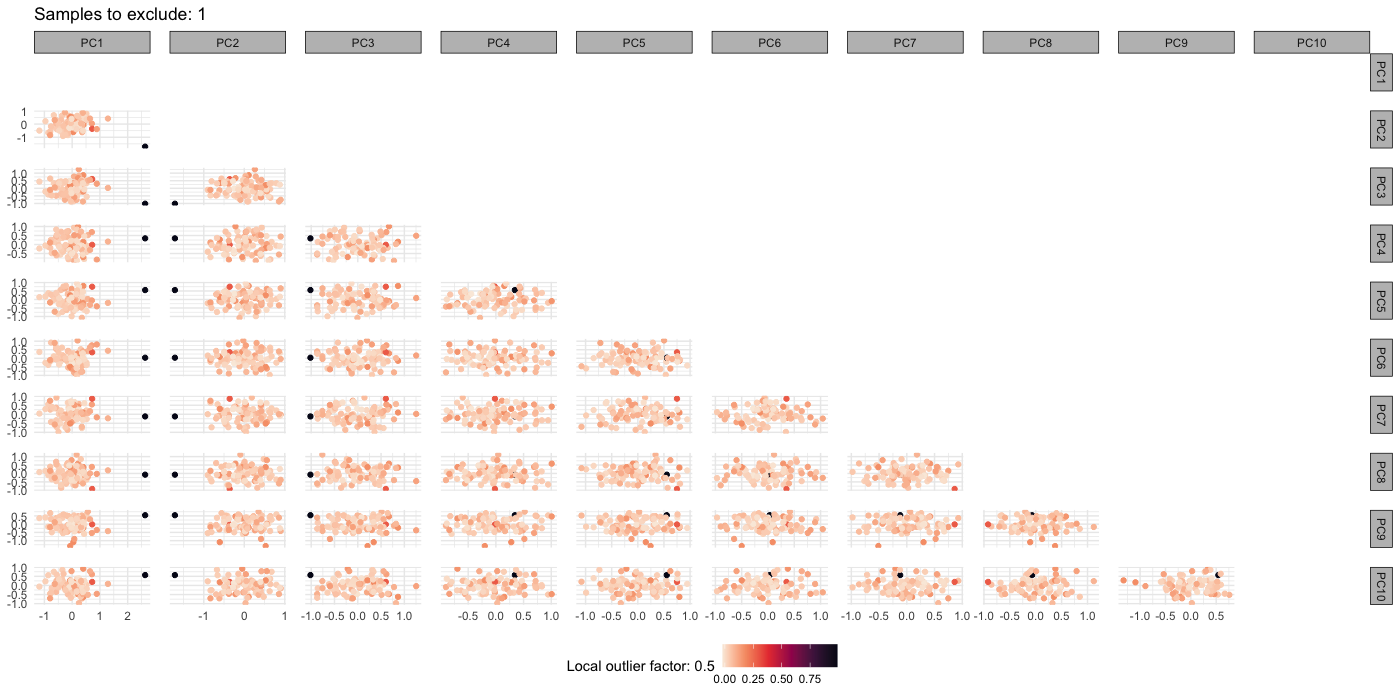
Plate correction
You can perform plate correction by providing sample and feature meta-data files.
data_processed <- process_data(
  data = data_features,
  data_meta_samples = data_meta_samples,
  col_samples = "ID_sample",
  data_meta_features = data_meta_features,
  col_features = "ID_feature",
  plate_correction = TRUE,
  cols_listRandom = c("batch"),
  cols_listFixedToKeep = c("age"),
  cols_listFixedToRemove = c("sex"),
  col_HeteroSked = NULL)
Other
Centering and scaling can be performed using
centre_scale = TRUE. Centering and scaling is performed for
log based transformations at the point of the transformation, regardless
of if centre_scale = TRUE.
If you are processing case-control data then you will likely want to
ensure excluded samples have their matched samples also excluded. This
can be done using case_control = TRUE and providing the
column name in data_meta_samples which has the matching
factor, col_case_control = case_control_match.
The processed data, the IDs for excluded samples and features and the
reasons for exclusions, and the outlier plot can be saved using
save = TRUE and providing a file path for the processed
data (path_out = path/to/directory/) and the exclusion data
(path_outliers = path/to/directory/exclusions/)
References
- Application of linear mixed models to remove unwanted variability
(e.g., batch) and preserve biological variations while accounting for
potential differences in the residual variances across studies (Viallon
et al., 2021). The functions implementing this
(
normalization_residualMixedModels()andFUNnormalization_residualMixedModels()) utilise the R packages{pcpr2},{lme4}, and{nlme}- Viallon V, His M, Rinaldi S, et al. A New Pipeline for the Normalization and Pooling of Metabolomics Data. Metabolites. 2021;11(9):631. Published 2021 Sep 17. doi:10.3390/metabo11090631.
-
{PCPR2}: Fages & Ferrari et al. (2014) Investigating sources of variability in metabolomic data in the EPIC study: the Principal Component Partial R-square (PC-PR2) method. Metabolomics 10(6): 1074-1083, doi: 10.1007/s11306-014-0647-9 - lme4: Bates, D., Mächler, M., Bolker, B., & Walker, S. (2015). Fitting Linear Mixed-Effects Models Using lme4. Journal of Statistical Software, 67(1), 1–48. doi.org/10.18637/jss.v067.i01.
- nlme: Pinheiro, J. C. & Bates, D. M. Mixed-Effects Models in S and S-PLUS. (Springer, New York, 2000). doi:10.1007/b98882
- Sample exclusion performed using principal component analyses and a
local outlier factor (Breuing et al., 2000) using a Tukey rule (Tueky,
1977) modified to account for skewness and multiple testing (Hubert and
Vandervieren, 2008)
- Markus M. Breunig, Hans-Peter Kriegel, Raymond T. Ng, and Jörg Sander. 2000. LOF: identifying density-based local outliers. SIGMOD Rec. 29, 2 (June 2000), 93–104. doi.org/10.1145/335191.335388
- Tukey, J. W. Exploratory Data Analysis. (Addison-Wesley Publishing Company, 1977).
- Hubert, M. and Vandervieren, E., (2008), An adjusted boxplot for skewed distributions, Computational Statistics & Data Analysis, 52, issue 12, p. 5186-5201, EconPapers.repec.org/RePEc:eee:csdana:v:52:y:2008:i:12:p:5186-5201.
- The implementation of sample exclusions is from the R package
{bigutilsr}and is described in detail by Florian Privé in this blog post